



Is Your Child Lazy or Struggling with Executive Function?

Manasi Valluri
By Manasi Valluri | Founder, MANAS Learning | Educational Psychologist
Is My Child Lazy or Struggling with Executive Function?
By Manasi Valluri | Founder, MANAS Learning | Educational Psychologist

The Word That Breaks My Heart
In fifteen years of working with children who learn differently, there is one word that consistently makes me pause when I hear it from parents: lazy.
'She is just lazy.' 'He could do it if he tried.' 'She doesn't even attempt it.' 'He starts things and never finishes them.' 'She knows the answer but won't write it down.' 'He's smart enough — he's just not trying.'
I understand why parents reach this conclusion. When a child with obvious intelligence consistently fails to do what seems simple — start a task, pack their bag, write down their homework, plan for a deadline — it looks, on the surface, like a motivational problem. A choice. A deficiency of character.
But in almost every case I have encountered in my clinical work at MANAS Learning, what appears to be laziness is actually a weakness in executive function. And that is not a moral failing. It is a neurological one.
What Is Executive Function?
Executive function is an umbrella term for a set of higher-order cognitive skills that are managed by the prefrontal cortex — the most recently evolved part of the human brain. These skills include:

- Task initiation: The ability to begin a task without excessive procrastination or avoidance.
- Planning and organisation: The ability to break a goal into steps, sequence them logically, and track progress.
- Working memory: Holding information in mind while using it — essential for following multi-step instructions.
- Cognitive flexibility: Shifting between tasks or strategies without excessive difficulty.
- Impulse control: Inhibiting the first (often unhelpful) response in favour of a more considered one.
- Emotional regulation: Managing frustration, disappointment, and overwhelm constructively.
- Time management: Accurately perceiving how long tasks take and allocating time accordingly.
The Developmental Reality
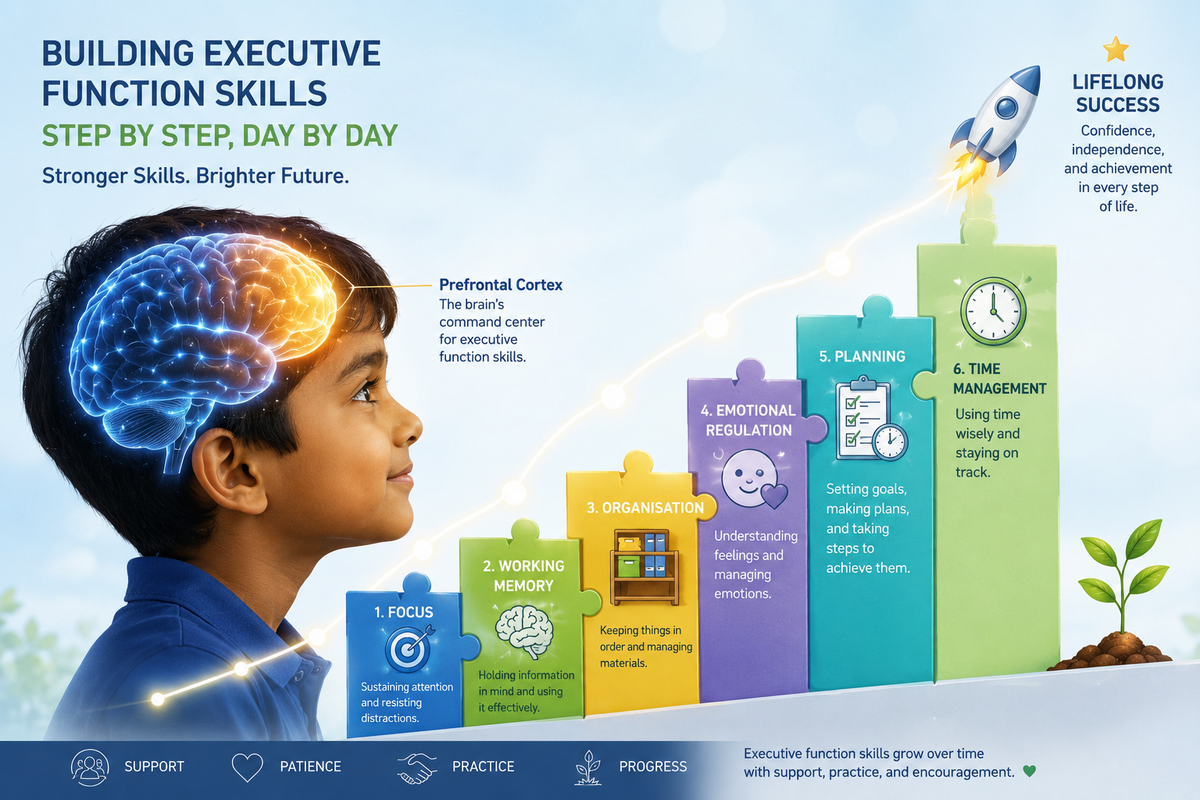
Here is what most parents — and many teachers — do not know: the prefrontal cortex, which houses executive function, is the last part of the brain to mature. It continues developing until a person's mid-twenties. In children, executive function is quite literally a work in progress.
This means that the eight-year-old who cannot organise their school bag is not lazy. Their organisational system is still under construction. The twelve-year-old who cannot begin a project until the night before the deadline is not irresponsible — their time-perception circuitry is still developing. And the child with ADHD, for whom executive function development can lag by three to five years compared to neurotypical peers, is working with a prefrontal cortex that is genuinely less developed than their chronological age suggests.
What Executive Function Difficulties Look Like in Real Life
- Starting homework only after enormous parental pressure, and then abandoning it halfway through.
- Brilliant verbal ideas that never make it onto the page.
- Lost items daily — water bottle, PE kit, library book — despite repeated reminders.
- Inability to manage multi-step tasks independently (getting ready in the morning, packing a bag).
- Extreme difficulty transitioning between activities ('one more minute' becomes forty).
- Emotional explosions that seem wildly disproportionate to the trigger.
- Knowing what to do but being completely unable to start.
- Poor time sense: genuinely surprised when they are late, even though forty-five minutes have passed.
The Damage the 'Lazy' Label Does
When a child with executive function difficulties is labelled as lazy, something very specific happens in their psychology. They internalise the label. They begin to believe that their struggles reflect a fundamental character flaw — that they are not trying, not good enough, not capable. This belief becomes the soil in which school refusal, anxiety, depression, and profound academic disengagement grow.
I have sat with teenagers who have spent years believing they were lazy — watching the relief flood their faces when they hear for the first time that their brain works differently, not defectively. That their struggles have a name, a neurological basis, and an evidence-based path forward. The shift in a child's self-concept when this happens is remarkable.
What Actually Helps

Executive function skills can be built — but they must be scaffolded externally first, because a child cannot bootstrap a skill their brain has not yet developed. Telling a child to 'just try harder' is like telling a child with a broken leg to just walk faster. The scaffold has to come first.
At MANAS Learning, we work with families on a combination of strategies:
- Externalise systems: Checklists, visual timetables, and organisational tools reduce the working memory load of task management.
- Break tasks into micro-steps: A ten-step project becomes manageable when each step is named, sequenced, and tracked.
- Front-load initiation support: Starting is the hardest part. Sitting with your child for the first five minutes of a task dramatically increases the likelihood they will continue.
- Use timers and visual time cues: Children with poor time perception need external time anchors.
- Reduce shame and increase curiosity: Changing the conversation from 'why won't you try?' to 'what is making this hard?' changes everything.
- Seek professional assessment: When executive function difficulties are significantly affecting a child's daily functioning and academic performance, a comprehensive psychoeducational assessment is the most powerful next step.
Your Child Is Not Lazy. They Need a Different Kind of Support.
At MANAS Learning, we have worked with hundreds of children who were labelled lazy, unmotivated, or difficult — and found, beneath those labels, children who were trying harder than anyone realised. Children whose brains were working overtime to compensate for executive function gaps that no one had identified or supported.
Every child deserves to be understood. Not judged by the output of a brain that has not yet received the support it needs. If this blog has described your child, please reach out to us. The understanding you gain from a professional assessment may be the most important gift you ever give your child.
📞 Book a free consultation at manaslearning.com — because every child deserves to be understood.
Topics
About the Author

Manasi Valluri
By Manasi Valluri | Founder, MANAS Learning | Educational Psychologist