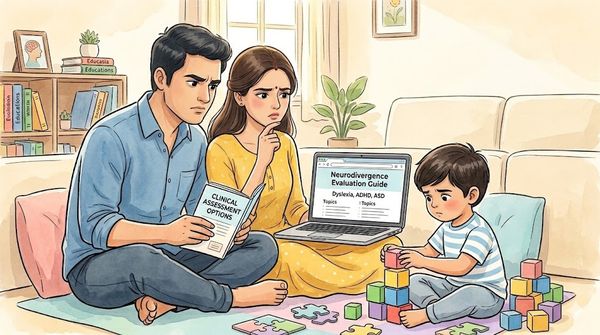



Child Not Focusing? It Could Be ADHD – What to Do Next

Manasi Valluri
Clinical Psychologist | 10+ Years | 3,500+ Child Assessments
What Parents Are Really Experiencing
Let me be honest with you — I have sat across from more than 3,500 families in my consulting room over the past decade. And if there is one phrase I hear more than any other, it is:
"My child is just not focusing."
- Parents are exhausted
- Teachers are frustrated
- And in the middle is a child who is struggling
If your child is not focusing — if they cannot sit still, cannot finish tasks, cannot seem to listen — this blog is written for you.
- Not to alarm you
- Not to label your child prematurely
- But to help you understand what may be happening
"A child not focusing is not a child being difficult. A child not focusing is a child who may be carrying a neurological challenge that no amount of scolding can fix."

Understanding ADHD: More Than Just “Not Paying Attention”
Attention-Deficit/Hyperactivity Disorder (ADHD) is a well-researched neurodevelopmental condition.
Key Facts:
- Defined by DSM-5 as patterns of:
- Inattention
- Hyperactivity
- Impulsivity
- Interferes with functioning and development
- Affects 5–7% of children globally
Important Clinical Insight:
A child not focusing can also be due to:
- Anxiety
- Sleep disorders
- Trauma
- Environmental stress
When ADHD Becomes a Consideration:
- Persistent across home, school, and social settings
- Present since early childhood
A thorough, multi-informant psychological assessment is non-negotiable.
Three Presentations of ADHD You Need to Know
1. Predominantly Inattentive
- Daydreaming
- Forgetting instructions
- Losing belongings
- Appearing “switched off”
- Often missed, especially in girls
2. Predominantly Hyperactive-Impulsive
- Constant movement
- Blurting out answers
- Difficulty waiting
3. Combined Presentation
- Mix of inattentive + hyperactive symptoms
- Most commonly seen

How Life Has Changed — And Why It Matters
Then (20 Years Ago):
- Outdoor play
- Unstructured activities
- Healthy boredom
Now:
- Screens after school
- Meals with devices
- Screen-based bedtime routines
What Research Shows:
- Unstructured play supports prefrontal cortex development
- Essential for:
- Attention regulation
- Impulse control
- Executive functioning
"The brain of a child in 2025 is navigating a world it was never evolutionarily designed for."
Screen Time, Dopamine, and Attention
What’s Happening Neurologically:
- Short-form content triggers rapid dopamine cycles
- Brain adapts to:
- Fast stimulation
- Instant rewards
Research Findings:
- Higher screen time → poorer attention outcomes
2 hours/day → increased attention problems
Real-World Impact:
- Classroom learning feels “too slow”
- Sustained attention becomes difficult
A child not focusing may be experiencing a neurological mismatch, not defiance.
ADHD vs Screen Exposure: How to Tell the Difference

ADHD:
- Neurodevelopmental condition
- Structural brain differences (research-backed)
- Present from early childhood
Screen Overexposure:
- Mimics ADHD symptoms
- Can worsen existing ADHD
- Delays attention development
Clinical Evaluation Must Include:
- Age of onset
- Symptoms across settings
- Family history
- Sleep quality
- Trauma history
- Screen time patterns
Not all attention issues are ADHD — but all require careful assessment.
Warning Signs Every Parent Should Watch
When It’s More Than Occasional:
- Daily struggles with focus
- Teacher concerns
- Homework battles
- Social difficulties
Warning Signs Every Parent Should Watch
When It’s More Than Occasional:
- Daily struggles with focus
- Teacher concerns
- Homework battles
- Social difficulties
Inattention Markers:
- Careless mistakes
- Difficulty sustaining attention
- Not listening
- Not completing tasks
Hyperactivity/Impulsivity Markers:
- Fidgeting
- Leaving seat frequently
- Excessive talking
- Interrupting others
Warning Signs Every Parent Should Watch
When It’s More Than Occasional:
- Daily struggles with focus
- Teacher concerns
- Homework battles
- Social difficulties
Inattention Markers:
- Careless mistakes
- Difficulty sustaining attention
- Not listening
- Not completing tasks
Hyperactivity/Impulsivity Markers:
- Fidgeting
- Leaving seat frequently
- Excessive talking
- Interrupting others
Diagnostic Criteria:
- Present for 6+ months
- Seen across multiple settings
- Causes functional impairment
- Present for 6+ months
- Seen across multiple settings
- Causes functional impairment
- Careless mistakes
- Difficulty sustaining attention
- Not listening
- Not completing tasks
Hyperactivity/Impulsivity Markers:
- Fidgeting
- Leaving seat frequently
- Excessive talking
- Interrupting others
Diagnostic Criteria:
- Present for 6+ months
- Seen across multiple settings
- Causes functional impairment

What To Do Next: A Clear Action Plan
Step 1 — Document Observations
- When does the child not focus?
- What triggers it?
- Patterns matter
Step 2 — Speak to the School
- Compare behaviour at home vs school
Step 3 — Consult a Professional
- Clinical psychologist
- Developmental paediatrician
- Child psychiatrist
Step 4 — Get a Comprehensive Assessment
Includes:
- Cognitive testing
- Behavioural scales (parent + teacher)
- Developmental history
- Academic evaluation
Step 5 — Review Lifestyle Factors
- Sleep
- Physical activity
- Nutrition
- Screen time
What Works: Evidence-Based Interventions
Proven Approaches:
- Behavioural Parent Training (BPT)
- Behavioural therapy
- Academic accommodations
- Medication (when required)
At Home:
- Structured routines
- Break tasks into small steps
- Limit screen time
- Ensure adequate sleep
- Increase outdoor activity
Early intervention leads to significantly better outcomes.
A Message Every Parent Needs to Hear
"You are not a bad parent because your child is not focusing. You are a good parent because you are asking the right questions."
Final Thoughts
- Every child deserves to be understood
- Not focusing is a signal, not a failure
- Some children need help navigating how their brain works
With the right:
- Support
- Structure
- Understanding
They can achieve extraordinary outcomes.
When to Take Action
If your child is not focusing and you are worried:
- Trust your instinct
- Seek professional help
- Get a proper assessment
Earlier intervention = better outcomes. Every time.
Key References
- Polanczyk, G.V., et al. (2015)
- Madigan, S., et al. (2019)
- Hoogman, M., et al. (2017)
- Cortese, S., et al. (2018)
- Wolraich, M., et al. (2019)
- Cheng, S., et al. (2020)
- American Psychiatric Association (2013)
Disclaimer
This blog is for educational awareness purposes.
It does not constitute a clinical diagnosis.
Please consult a qualified mental health professional for individual assessment.