


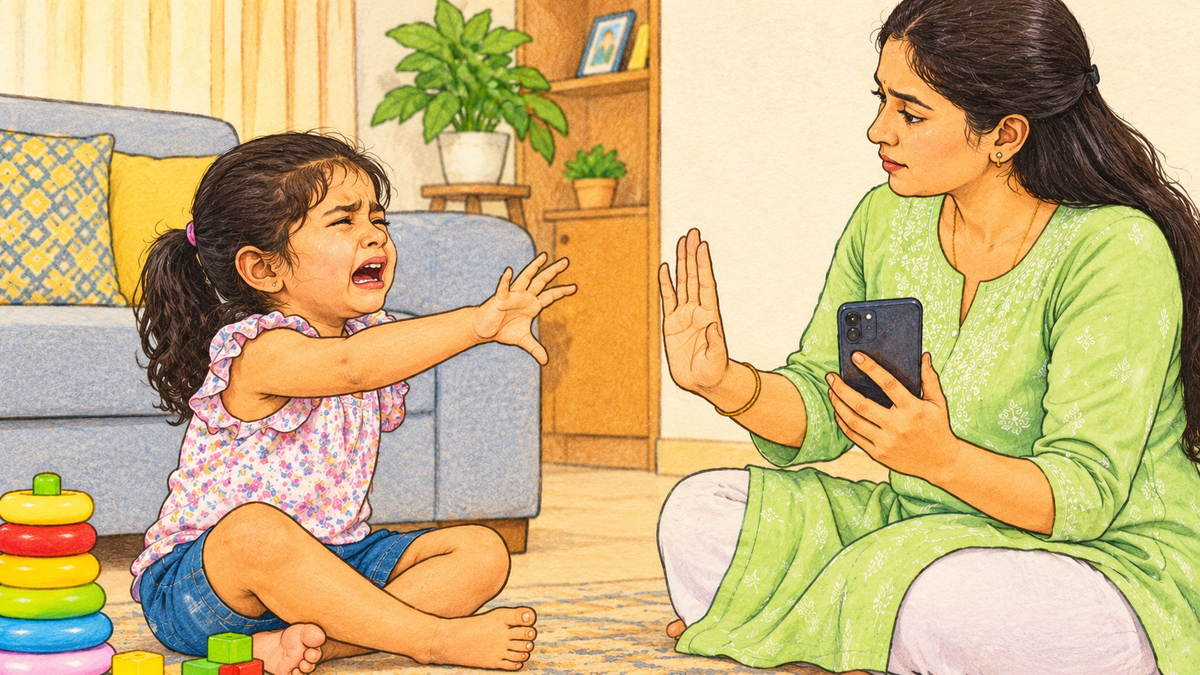
Tantrum or Meltdown? How to Tell the Difference and What to Do in the Moment

Manasi Valluri
By Manasi Valluri | Founder, MANAS Learning | Educational Psychologist
Your child is on the floor of the supermarket, screaming. People are staring. You are trying to work out whether you should give in, walk away, stay firm or pick up and leave.
The right response depends on what you are dealing with. Tantrums and meltdowns can look very similar from the outside, but they usually come from different places inside the child. Knowing which one you are seeing can change how you respond.
A note before we begin: "tantrum" and "meltdown" are everyday words and not formal diagnostic categories. Any child can have either, and the two can overlap. The distinction below is a practical tool for parents. It is not a test.

What is a tantrum?
A tantrum is a common part of development in toddlers and preschoolers. Young children are still learning to manage big emotions with limited language and self-control. Research on typical tantrums shows that they are common in the preschool years, that they often include crying, yelling, stiffening or dropping to the floor, and that most are short (Potegal & Davidson, 2003).
Tantrums are usually goal-directed. The child wants something (a biscuit, the tablet, to stay at the park) or does not want something (to leave, to wear the shoes). Features of a tantrum include:
- It starts after a "no" or a frustrating situation
- The child often watches to see your reaction
- It may stop quickly if the child gets what he wants, or when he is distracted or calms down
- The child can usually be comforted, and recovers fairly quickly
What is a meltdown?
A meltdown is better understood as an overload response. Sensory, emotional or cognitive demands exceed what the child can cope with, and the child's regulation system is overwhelmed. It is often described in autistic children, but it is also seen in children with ADHD, sensory processing difficulties, anxiety and others. Research on emotion regulation in autism shows that difficulties with regulating emotions are common and contribute to behavioural outbursts (Mazefsky et al., 2013).
Features of a meltdown include:
- It is not about getting something. Giving the child what he "asked for" does not end it.
- It is not for an audience. It may happen in front of nobody.
- The child may seem unreachable. He cannot listen to reasoning or instructions.
- There may be an escape or freeze response, such as running away, hiding, covering ears or going silent, and sometimes hitting out or self-injury because the child is overwhelmed, and not because he intends to hurt.
- Recovery takes longer, and the child is often exhausted, tearful or withdrawn afterwards.

Tantrum vs. Meltdown: Understanding the Difference
1. Purpose
Tantrum: To get something or avoid something.
Meltdown: A reaction to sensory or emotional overload; there is no specific goal.
2. Audience
Tantrum: The child may watch your response or check whether someone is paying attention.
Meltdown: Happens with or without an audience.
3. Control
Tantrum: The child may retain some control over their behaviour.
Meltdown: The child loses control due to overwhelming emotions or sensory input.
4. When It Ends
Tantrum: May end when the child gets what they want or calms down.
Meltdown: Ends when the overload reduces and the child gradually recovers.
5. Reasoning
Tantrum: The child may respond to calm explanations or reasoning once they settle.
Meltdown: The child may be unable to process language or reasoning during the episode.
6. Afterwards
Tantrum: The child may recover relatively quickly.
Meltdown: The child may experience exhaustion, distress or withdrawal.
Important note: These are general differences, not strict rules. Every child is different, and a child's behaviour should be understood in the context of their developmental, emotional and sensory needs. A meltdown is not intentional misbehaviour.

Common meltdown triggers
- Noise, bright lights, crowds, strong smells or textures
- Sudden changes in routine or transitions between activities
- Hunger, tiredness or illness
- Too many demands at once, such as after a full school day
- Difficulty communicating needs
- Social situations that are confusing or tiring
Early warning signs
Many children give signals before a meltdown. These include covering ears, pacing, increased stimming (repetitive movements), irritability, going quiet, asking the same questions repeatedly, or clinging. Watching for your child's own signals gives you a chance to step in early.
What to do during a meltdown
- Make it safe. Move objects away or guide your child away from danger. Do not restrain unless safety requires it.
- Lower the input. Reduce noise, light and people. If possible, move to a quieter space.
- Say very little. Use a calm, low voice and a few short phrases such as "I am here. You are safe."
- Do not reason, bargain or lecture. Your child cannot process language right now.
- Stay close but give space. Some children want a hug, and some find touch too much. Learn which yours is.
- Do not punish. A meltdown is not misbehaviour.
- Wait for recovery. Offer water, a favourite comfort item or quiet time afterwards.
What to do during a tantrum
- Stay calm and keep your limit. If you give in, your child learns that tantrums work.
- Keep your child safe and ignore the behaviour, not the child. Stay nearby and wait.
- Acknowledge the feeling briefly: "You wanted more time. That is hard."
- Praise calm behaviour when it returns.
- Offer limited choices before the next trigger, such as "Do you want to leave now or after two more slides?"
Preventing both
- Use visual schedules and warnings such as "Five more minutes, then we leave".
- Keep routines predictable, with regular sleep and meals.
- Teach your child words, pictures or gestures to ask for a break, for help and for "all done".
- Plan sensory breaks such as movement, deep pressure or a quiet corner, as suggested by an occupational therapist.
- Reduce demands on tired or overwhelmed days.
- Keep an ABC record. Write down what happened before (Antecedent), what your child did (Behaviour) and what happened after (Consequence). Patterns often appear within a week or two and show you what to change.

When to seek professional help
An evaluation is worth considering if:
- Outbursts are very frequent, long or intense for your child's age. Research on preschoolers has found that tantrums that are very frequent, prolonged or involve aggression toward people deserve clinical attention (Belden et al., 2008).
- Your child hurts himself or others, or damages property
- Outbursts continue at the same intensity beyond preschool age
- Meltdowns are tied to sensory overload, communication difficulties or social difficulties
- They are interfering with school, friendships or family life
- You see a sudden change or regression
- You feel exhausted, overwhelmed or unable to cope

A good assessment looks at sensory processing, communication, attention, emotional regulation and the home and school environment, and the plan that follows gives you practical strategies. Behaviour is communication, and understanding what your child is communicating is the first step in changing it.
CTA
Book a free counselling session | Try our "Experience What They Feel" page | Ask about Parent Counselling and the Home Program
Suggested lead magnet: "Tantrum or Meltdown? Pocket Guide" with the comparison table, calming steps and a printable ABC tracking sheet.
References
- Belden, A. C., Thomson, N. R., & Luby, J. L. (2008). Temper tantrums in healthy versus depressed and disruptive preschoolers: Defining tantrum behaviors associated with clinical problems. The Journal of Pediatrics, 152(1), 117-122.
- Mazefsky, C. A., et al. (2013). The role of emotion regulation in autism spectrum disorder. Journal of the American Academy of Child & Adolescent Psychiatry, 52(7), 679-688.
- Potegal, M., & Davidson, R. J. (2003). Temper tantrums in young children: 1. Behavioral composition. Journal of Developmental & Behavioral Pediatrics, 24(3), 140-147.