



Dyscalculia: The Learning Disability As Common As Dyslexia — That Almost Nobody Talks About
Manasi Valluri
By Manasi Valluri | Founder, MANAS Learning | Educational Psychologist
She reads two grades ahead. Her essays are articulate, her vocabulary is sharp, and her teachers describe her as bright. Then math homework starts, and something changes: tears, shutdowns, a stomachache that appears right before the worksheet comes out. Parents are told she's “just not a math person,” or that she needs to focus harder. What's actually happening, for a meaningful number of these children, has a name most parents have never heard: dyscalculia.

You know dyslexia. You've probably heard of dysgraphia. But dyscalculia — a specific learning disability affecting the ability to understand numbers and perform mathematical operations — remains, by the research's own description, nearly as common as dyslexia yet studied far less, understood far worse, and diagnosed far less consistently.
How common is it, really?
Estimates vary depending on how strictly the condition is defined, but most research converges on a prevalence of roughly 3% to 8% of school-aged children, with several reviews citing figures in the 5-7% range — essentially the same order of magnitude as dyslexia. One widely-cited estimate places the core, lifelong form of the disability at closer to 2%, while broader definitions that include milder, persistent math difficulty push the figure toward 8%.
Put simply: in a classroom of 30 children, there's a reasonable chance one or two are dealing with a genuine, diagnosable difficulty processing numbers — not a motivation problem, not a teaching-method problem, but a specific learning disability with its own distinct cognitive profile.
Despite this scale, awareness lags far behind dyslexia's. Most parents can describe what dyslexia looks like in broad strokes; far fewer have heard the word dyscalculia at all, let alone know what signs to watch for. That awareness gap has real consequences: dyslexia screening is now routine in many schools, while a child with equally significant, equally diagnosable difficulty with numbers can go through years of schooling with nobody ever suggesting the word.
It frequently travels with dyslexia — and gets overshadowed by it
About half of children with dyscalculia also have dyslexia, and dyscalculia is present in roughly 11% of children with ADHD, with up to 45% of children with ADHD having some kind of learning disorder overall. This overlap is part of why dyscalculia flies under the radar: when a child already has a dyslexia or ADHD diagnosis and support plan in place, math difficulties are often assumed to be a downstream effect of the primary diagnosis, rather than a distinct condition that needs its own targeted intervention.
What the research says is actually happening
Contrary to the “not a math person” framing, dyscalculia research points to specific, identifiable cognitive differences. Pioneering research by Dr. David Geary at the University of Missouri has consistently shown that children with math difficulty have poor working memory, which compromises their ability to carry out calculation procedures and hold intermediate steps in mind while solving a problem — which in turn makes it harder to store arithmetic facts in long-term memory the way most children eventually do.
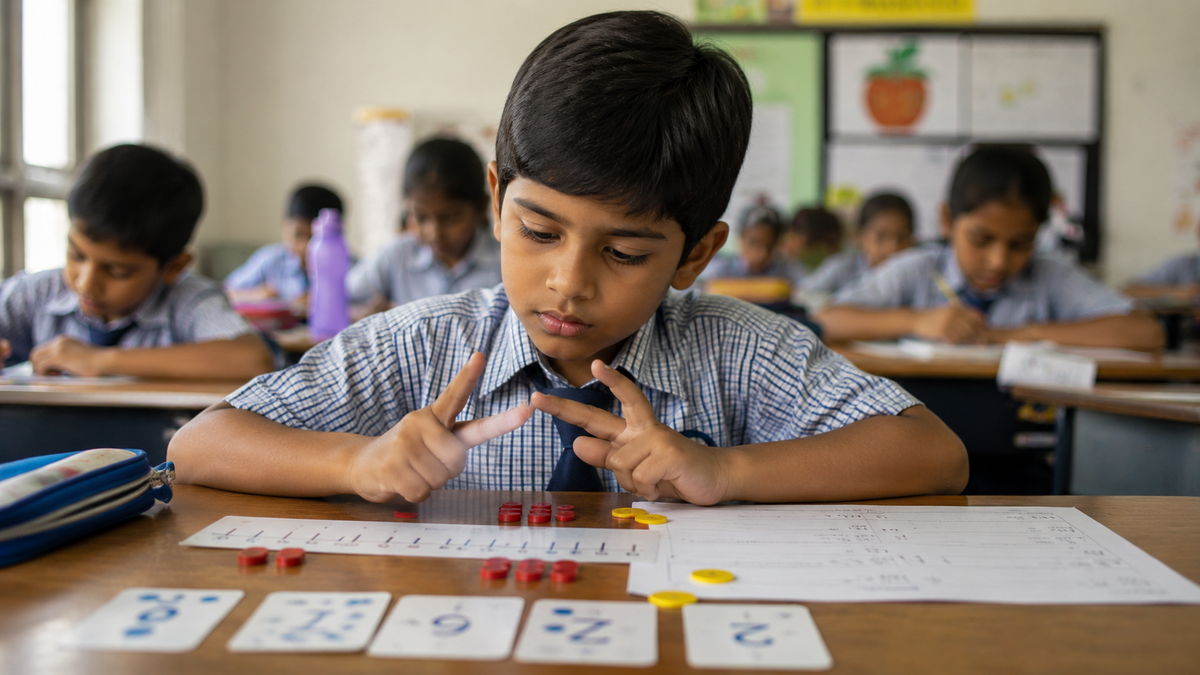
This shows up in observable, testable patterns: children with developmental dyscalculia typically take longer than peers to complete standardized math tasks, and they continue relying on finger-counting and other basic counting strategies long after classmates have moved on to retrieving facts from memory automatically. Neuroimaging research adds a physical dimension to this: one fMRI study found children with dyscalculia showed hyperactivity in the hippocampus during tasks involving perceiving numerical symbols, suggesting their brains are working harder, using different circuitry, to process the same numerical information that comes automatically to typically developing peers.
Researchers distinguish between two overlapping difficulties that can look similar from the outside: a core deficit in perceiving quantities themselves (struggling even with basic size or amount comparisons), versus an access deficit specifically in connecting numerical symbols (the digit “7”) to the quantity they represent. Children with dyscalculia — and especially those with both dyscalculia and dyslexia — often struggle specifically at this symbol-to-quantity connection point, which is precisely why drilling more worksheets doesn't fix the underlying issue.

Signs by age
Early signs (preschool/early primary) include trouble recognising numbers, difficulty counting objects reliably, and confusion with basic concepts like “more” and “less.” As children get older, the signs shift: difficulty remembering sequences of numbers (phone numbers, addresses), confusion telling left from right, trouble reading analog clocks or judging how much time has passed, and persistent difficulty estimating distances or quantities that peers judge quickly and intuitively.
The impact reaches well beyond the classroom. Children with dyscalculia often struggle with everyday tasks involving numbers — counting change, calculating a tip, understanding how much time is left before they need to leave — which can affect independence and confidence far beyond report cards.
The emotional toll is real, and it's not incidental
Because dyscalculia is so poorly recognised, many children internalise their math struggles as a personal failing rather than a distinct, addressable learning difference. Clinical descriptions of dyscalculia consistently note significant emotional symptoms alongside the academic ones: anxiety and even panic specifically around math tasks, agitation or frustration that can look like a behaviour problem, and in some children a genuine fear of school built entirely around the anticipation of a math class or test. These emotional symptoms often show up as physical ones too — stomachaches, nausea — right before math homework or an exam, which is exactly the pattern many parents describe without realising there's a name and a research base behind it.

What actually helps
Effective intervention for dyscalculia doesn't look like more of the same worksheets, done more slowly. Research-backed approaches focus on rebuilding number sense from the ground up — explicit instruction in subitizing (recognising small quantities instantly without counting), multisensory and visual representations of numbers rather than abstract symbols alone, and structured, sequential teaching of the specific skills (like moving from counting-based to memory-based fact retrieval) that dyscalculia disrupts. Reducing math anxiety alongside the skill-building matters just as much as the academic content itself — a child who has learned to dread math will resist even well-designed instruction until that fear is addressed directly.
What this means in the classroom
For teachers, the practical implication is treating persistent, disproportionate math struggle as a possible signal worth raising with parents directly — not evidence of low effort or a fixed “math ability.” Reasonable classroom accommodations for a child with suspected or diagnosed dyscalculia include allowing extra time on math tasks and tests, permitting the use of visual aids (number lines, multiplication charts) well past the age peers have stopped needing them, and breaking multi-step word problems into smaller, explicitly sequenced parts rather than expecting a child to hold the whole problem in working memory at once.
It also helps to separate math ability from math performance under pressure. A child who understands a concept perfectly in a calm, one-on-one setting but blanks during a timed classroom test isn't inconsistent or lazy — timed testing specifically taxes the working memory that dyscalculia already compromises, which is exactly why extended time is one of the most consistently effective accommodations rather than a minor convenience.
Comorbidity with dyslexia and ADHD also means dyscalculia screening shouldn't be an afterthought in a broader learning assessment. Because roughly half of children with dyscalculia also have dyslexia, and it appears in a meaningful share of children with ADHD, a comprehensive learning evaluation that only tests reading and attention risks missing a math-specific difficulty entirely — particularly since a child's strong verbal and reading skills can make math struggles look like an isolated, minor gap rather than a distinct learning disability in its own right.

What we recommend
If your child is thriving in reading and language but consistently, disproportionately struggling with math — especially alongside anxiety, avoidance, or physical symptoms tied specifically to math tasks — it's worth asking for a dyscalculia-specific assessment rather than accepting “not a math person” as an explanation. Given how often it overlaps with dyslexia and ADHD, it's also worth asking whether math-specific screening was included in any prior learning assessment your child has already had, since it's easily overshadowed by a more visible primary diagnosis.
Wondering if math struggles are more than “not being a math person”?
We've put together a simple observation checklist based on the research-backed signs of dyscalculia by age — so you can describe exactly what you're seeing at home and bring specific, useful detail into your next conversation with a teacher or assessor.
📥 Free download: "Is It Dyscalculia? A Parent’s Sign Checklist by Age" — a free worksheet covering early, primary, and pre-teen signs of dyscalculia, plus questions to ask when requesting a math-specific learning assessment.
References
1. Dyscalculia Definition: Symptoms & Treatment of the Math Learning Disability. ADDitude Magazine (2025).
2. What is Dyscalculia and How to Spot Dyscalculia Symptoms. Child Mind Institute (2025).
3. Dyscalculia & Math Anxiety: Signs, Symptoms, Diagnosis — research by David C. Geary, PhD. ADDitude Magazine (2025).
4. Dyscalculia Statistics and Prevalence: How Common Is It? Edublox Online Tutor (2026).
5. Children With Dyscalculia Show Hippocampal Hyperactivity During Symbolic Number Perception. PMC8330842.
6. Characteristics inhibition defects of children with developmental dyscalculia: Evidence from the ERP. PMC9583266.
7. Dyscalculia: What It Is, Causes, Symptoms & Treatment. Cleveland Clinic (2025).