


Autism & School Selection Regular School or Special School?
Manasi Valluri
Every parent of an autistic child eventually sits with the same knot in their stomach: regular school, or special school? Well-meaning relatives push one way. A neighbour's success story pushes the other. Somewhere in between is a child who just needs the right fit — not the option that sounds best at a dinner party.
Here's the uncomfortable truth research keeps confirming: there is no universally “better” option. What actually predicts a good outcome isn't the label on the school gate — it's whether the setting matches your child's current severity, cognitive profile, and functional skills, and whether that setting genuinely supports them once they're inside it.

What the research actually shows?
A UK archive-based analysis comparing National Curriculum outcomes for children with autism in mainstream versus special schools found something parents rarely hear: children in special schools had significantly more severe autism symptoms than those in mainstream settings to begin with — and once that starting difference was accounted for, mainstream placement did not produce greater academic success than specialist provision. In other words, the schools weren't competing on a level playing field, and neither one was inherently superior; children were already being placed according to their needs.
A separate longitudinal study using the Strengths and Difficulties Questionnaire and the Vineland Adaptive Behavior Scale found children with autism improved in both mainstream and special school placements over a school year — but those in specialist provision showed greater gains specifically in conduct and socialisation. Newer research adds an important nuance: changes in core autism symptoms over time were not strongly linked to which type of school a child attended, but were strongly linked to how early the child was diagnosed — children diagnosed earlier improved more, regardless of setting.
Recent work looking specifically at what drives initial placement decisions found that lower cognitive ability and higher levels of aberrant behaviours (like aggression or difficulty self-regulating) were the strongest predictors of a child being placed in special rather than mainstream education — more so than the core severity of autism symptoms alone. And a 2025 study on specialist resource centres embedded within mainstream schools found something worth remembering whichever path you choose: the single most important factor linked to positive outcomes for autistic pupils wasn't the setting type at all — it was whether the child felt supported by teachers and classmates.
Put together, this research points to one clear conclusion: severity of autism, cognitive functioning, adaptive daily-living skills, and behavioural regulation should drive the decision — not the general reputation of “regular” versus “special,” and not what worked for someone else's child.
So how do you actually decide?
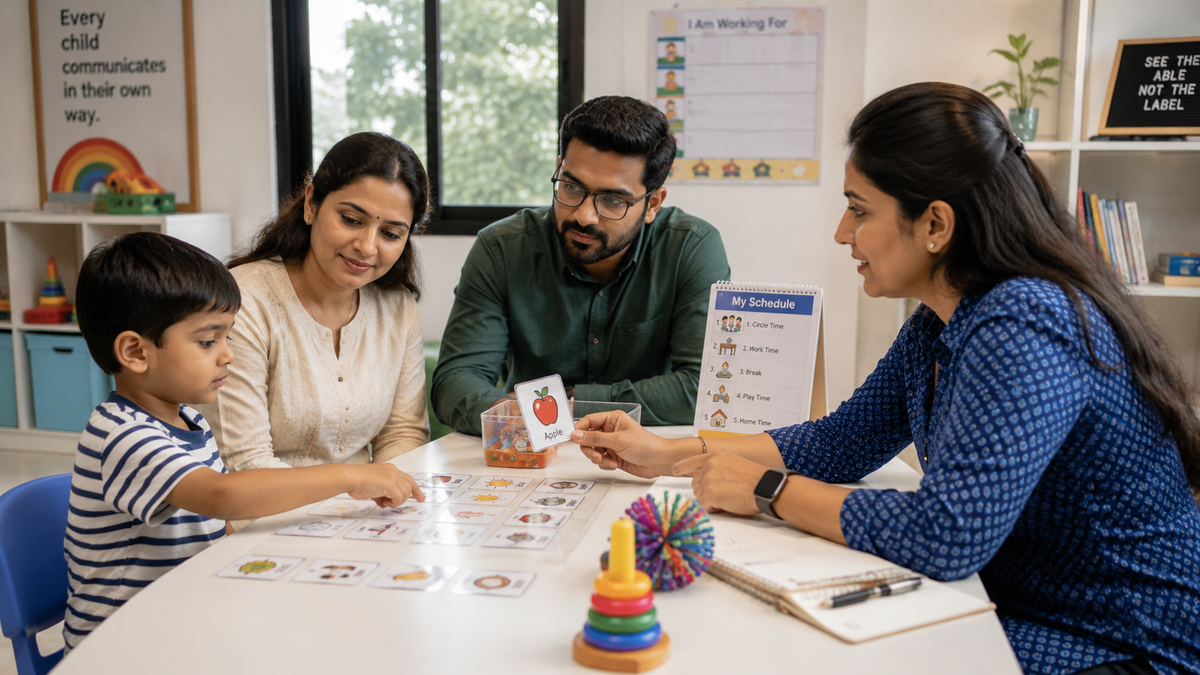
Rather than starting with the school type, start with your child's current profile:
- Communication: Can they express needs verbally, with AAC, or through gesture well enough to be understood by an unfamiliar adult in a group of 30?
- Self-regulation: How do they cope with noise, transitions, and unstructured time — with support, or with significant distress?
- Adaptive/daily-living skills: Can they manage toileting, eating, and basic self-care independently or with minimal prompting?
- Academic readiness: Can they engage with grade-level content with accommodations, or do they need a substantially modified curriculum?
- Behavioural regulation: Are there behaviours (aggression, elopement, self-injury) that need a lower staff-to-child ratio than a mainstream classroom can offer?
A child who is verbal, toilet-independent, and able to tolerate a classroom with some support may thrive in a regular school with the right shadow teacher and accommodations. A child with higher support needs across several of these domains may build more genuine skill — and more confidence — in a special school's lower ratios and specialised curriculum, at least for a period. And critically: this isn't a permanent, one-time decision. A child's needs change, and so should the setting, as often as the child's profile does.

Why school matters at all — beyond academics
It's worth naming why this decision carries so much weight in the first place. School isn't just where academic content is delivered — for an autistic child, it's often the single largest, most consistent source of structured peer interaction, communication practice, and independence-building outside the home. The research on specialist resource centres above makes this concrete: what predicted wellbeing wasn't the curriculum, it was whether the child felt genuinely supported and included by the people around them, every single day. That's not a soft, secondary outcome — it's arguably the outcome that matters most.
Food for the brain matters as much as food for the body
One piece parents often overlook entirely while agonising over school choice: what's happening at the dinner table matters to how a child functions in either setting. A growing body of research on the gut-brain axis has established that gut microbiota composition is linked to several neurodevelopmental conditions, including autism spectrum disorder and ADHD, and that healthy dietary patterns built around whole, minimally processed, high-fibre foods support the kind of microbial diversity that in turn supports brain function and development.
It's important to be precise here, because this area attracts a lot of overclaiming: rigorous reviews of restrictive elimination diets, like gluten-free/casein-free approaches, have found the evidence for improving core autism symptoms is genuinely mixed and inconclusive, with small sample sizes and inconsistent results across studies. The honest, evidence-backed message isn't “cut out gluten and casein and symptoms will resolve” — it's that consistent, balanced nutrition supports the same gut-brain pathways implicated in attention, mood regulation, and behaviour, which in turn affects how available a child is for learning, regardless of which school they attend. A dysregulated, poorly-fed child will struggle in the best special school and the best mainstream classroom alike — nutrition isn't a replacement for the right educational setting, but it is part of what makes any setting work.
What if neither option feels like enough right now?
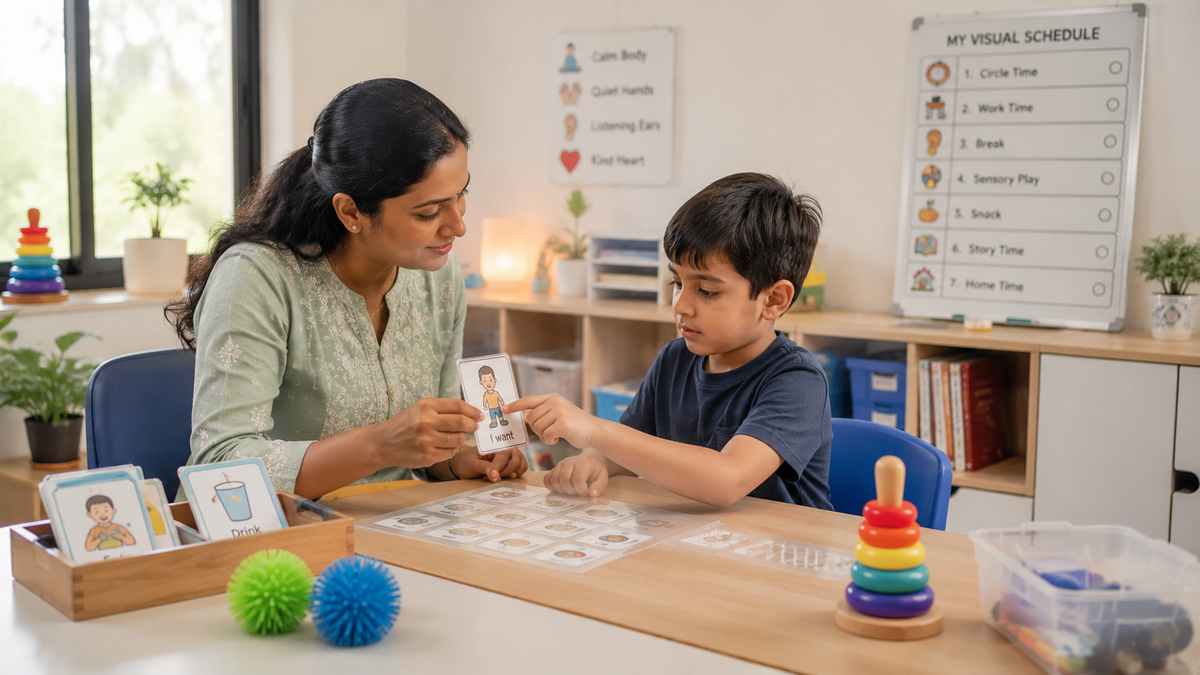
This is the gap almost nobody talks about directly: many families sit in the space between — a child not quite ready for a full mainstream day, but not necessarily needing (or wanting) full-time special school either. For these families, home-based special education support and structured homeschooling components can bridge that gap, giving a child individualised, one-on-one skill-building time that a group classroom of any kind simply cannot offer, while working toward readiness for whichever school setting fits best.
This is exactly the gap MANAS home programs were built to close. Rather than treating home-based support as a fallback for families who “couldn't get into” a school, we treat it as a deliberate, structured bridge: building the specific communication, self-regulation, and adaptive skills a child needs to succeed in a regular classroom — or consolidating academic and life skills alongside a special school placement — so that whichever school environment you choose, your child walks in more prepared, and stays supported in the gaps school alone can't fill.

The shadow teacher piece almost nobody gets right
If regular school is the chosen path, the single biggest variable in whether it actually works is the shadow teacher — and here the research is unusually clear about a mistake most families and schools make by default: treating the shadow teacher as a permanent presence rather than a temporary bridge to independence.
Research on paraprofessional support in inclusive classrooms consistently finds that well-intentioned constant support can backfire, creating a risk that the child becomes overly reliant on the adult beside them, which can actually get in the way of the independence school is meant to build. The research-backed alternative is a deliberate fading model: a shadow teacher starts with direct, close support, then systematically shifts toward indirect methods — natural classroom cues, peer supports, visual schedules, and increased physical distance — tracking data on how much support the child genuinely still needs as skills are gained.
A study specifically on shadow teaching for children with autism and ADHD in regular schools found that both shadow teachers and regular classroom teachers agreed shadow teaching genuinely improves academic performance, psychosocial skills, and independence — but only when the shadow teacher's most important job is understood correctly: not managing the child's every moment, but training the child to use the ordinary environment of the regular classroom (the teacher's instructions, the wall schedule, the peers around them) as the source of support, so the shadow can gradually step back.
This is precisely why we insist on structured shadow teacher training as part of any regular-school placement we support: a trained shadow teacher works from a fading plan from day one, collaborates closely with the classroom teacher rather than working in isolation, and measures success not by how smoothly the child gets through the day with help, but by how much less help the child needs month over month.
Not sure which setting — or which support — is right for your child today?
This decision isn't one you should have to make from a dinner-table debate or someone else's success story. Book a MANAS home program consultation and we'll assess your child's actual communication, self-regulation, adaptive, and academic profile together — and build a plan that bridges whatever gap exists between where your child is now and the classroom that will genuinely work for them, whether that's a regular school with a properly trained shadow teacher, a special school, or a structured home program in between.
📥 Free download: "Regular vs. Special School: A Parent’s Decision Framework" — a free worksheet to profile your child’s communication, self-regulation, adaptive, and academic readiness, plus a shadow-teacher-training checklist to bring to your child’s school if regular school is the chosen path.
References
1. Waddington, E.M. & Reed, P. (2017). Comparison of the effects of mainstream and special school on National Curriculum outcomes in children with ASD: an archive-based analysis. Journal of Research in Special Educational Needs.
2. Reed, P., Osborne, L.A. & Waddington, E.M. (2012). A comparative study of the impact of mainstream and special school placement on the behaviour of children with ASD. British Educational Research Journal, 38(5).
3. Cognitive abilities and irritability are the main factors influencing initial placement of autistic preschoolers in special or mainstream education (2025). medRxiv preprint.
4. The impact of specialist resource centres on autistic pupils' experience of mainstream school (2025). PubMed.
5. The role of nutrition and gut microbiome in childhood brain development and behavior. PMC12183074 (2025).
6. Gut microbiota and autism spectrum disorder: advances in dietary intervention strategies based on the microbiota-gut-brain axis mechanism. Frontiers in Neuroscience (2025).
7. Fading Paraprofessional Support: Strategies for Success in Inclusive Classrooms. Inclusive Schooling (2026).
8. Scheef, A.R. et al. (2023). Increasing the Independence of Students With Disabilities in the Classroom Through Indirect Paraprofessional Support.
9. Shadow Teaching Scheme for Children with Autism and Attention Deficit-Hyperactivity Disorder in Regular Schools.